Design Your Own Cloth Doll
Class
©1995 with additions copyrighted 1996-1997
Taught by Judi Ward of Judi's Dolls
Chapters 6 - Part 1
Methods of Face Design
Hopefully you have a doll, or several dolls ready for faces and hair. Many of you will already have faces on your dolls, because drawing faces is easy for you and a part of dollmaking that you love. What I will teach you, are ways to DESIGN faces if you do not draw faces free hand.
Some of you will paint the faces, some will use pens, crayons and colored pencils, and some will embroider. This is your doll design, so do the faces in any medium that you like and feel comfortable with. This class will not be teaching face finishing. It will be teaching methods for face designing for the non-artist. A doll’s face is often the special finishing touch that brings your creation to life, so if the finishing is hard for you, work at it on fabric, over batting, stretched across an embroidery hoop. Try lots of methods. There is a wealth of information on face finishing in every pattern that you own and in books too. You will come up with a medium, I.E. paint, crayon, pencils etc that you love and can do with ease if you practice. When you get a good face in the embroidery hoop, you can turn it into a doll now by designing one from the methods you just learned in class. The first method I will teach you is designing a face by drawing around ordinary household objects. The second method I will teach you is designing from a magazine photo of a real person.
When you can design the face yourself, your dolls are even more special, but many doll makers don't feel that they are artistic enough to design their own doll faces. With these methods you can. I do my dolls faces freehand, but have devised and tested methods of face designing that use paper, self stick labels, magazines, coloring books, greeting cards, and ordinary household objects to draw around for eyebrows, nose curves and shapes, irises of the eyes, eyebrows and eyelashes. Household objects to draw around, are coins, jars, toothpaste caps, buttons, pen caps, etc. You can design the faces in any size, then shrink them down to a variety of sizes on a copy machine.
After you design a face and size it for your doll, you will transfer the features to the Self-Stick Labels. (Avery is one brand of these labels) Then you will cut them out, place them on your doll’s stuffed head and draw JUST UNDER THE EDGE of the cut outs VERY LIGHTLY with a VERY sharp pencil, or colored pencil of nearly the same shade as your doll’s skin. REMEMBER! When you draw AROUND something it gets bigger, so you want to draw JUST UNDER THE EDGE of your cut outs, or your face may be too big.
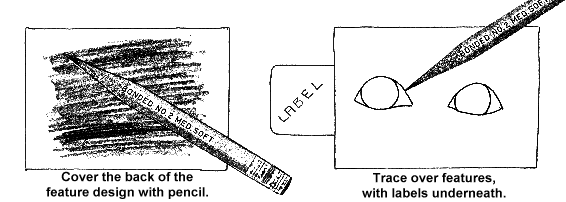
The way you transfer the features to the labels is to first cover the back of the paper the features are on with pencil, by holding the pencil sideways, and rubbing it back and forth until the features have pencil on the backs. Put a label under each feature, and then trace the feature. The pencil on the back of the paper will act like a carbon, and the feature shapes will be on the labels….NOTE…Don’t use freezer paper for this part, the pencil won’t transfer off to the label from freezer paper.
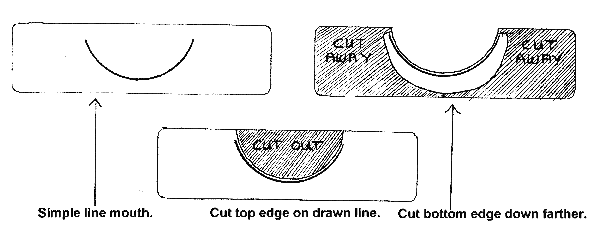
Features that are just lines can be cut from the labels but it’s a little hard to peel the backing off without tearing them. For the very simple line features you can probably freehand them if you just practice a little first.
If you do cut them from labels, cut right on the line you drew for the top edge and a little ways down for the bottom edge. You only need the top edge to draw around.
The easiest way to get the backing off of the labels after you cut a feature out, is to slip the point of a needle between the paper backing and the label. Be sure to have your bifocals tuned up for this part!
I WILL SHOW YOU MORE ABOUT HOW TO USE THE LABELS AFTER WE DESIGN A FEW FACES.
…First, Another Very Mini Anatomy Lesson…
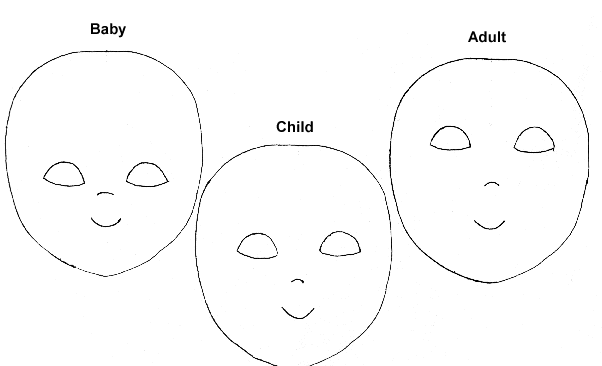
When designing a baby or child's face, the features are lower on the face than for an adult. The spacing of the features will make a great change in the look of your doll, that's why the labels are so great.
You can move the features around until you get the look you want. You can turn a child doll into a baby just by moving the features down on the face a little. You can even turn a child face into an adult face by moving the features up on the head. (Assuming of course that the body styles will be compatible.)
Feature locations for a...
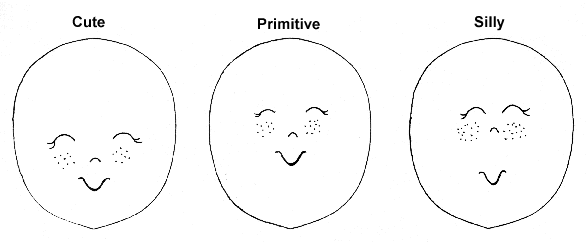
You can make the same doll look "cute" with lower features, "country/primitive" by raising the features, or silly by widening or narrowing the spaces between the features.
A few feature variations for...
By varying the features location in relation to each other, you can come up with different "looks" with the same set of features...or...you can mix and match features from several designs.
You only need to design one good eye or 1/2 of a good mouth shape because you can cut the mouth from a label folded in half and two eyes from a folded label. You can do a simple curved line nose, pointy line nose, stitched on nose, etc. Whatever is best in your opinion, for the doll you are designing. (Stitched on nose ideas later in this lesson)
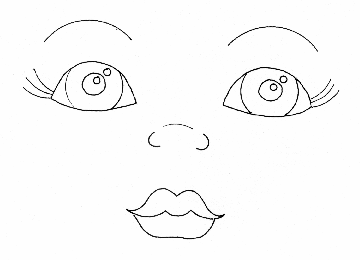
Below is a very simple face designed by using ordinary household objects to draw around. Eye shape from a quarter. Outer iris from a penny. Inner iris, or pupil from a dime. Mouth from a quarter, including the little lines at the sides of the mouth. Eyebrows from a quarter. Eyelashes from a quarter, Nose from a penny. Lifelites just little freehand dots.
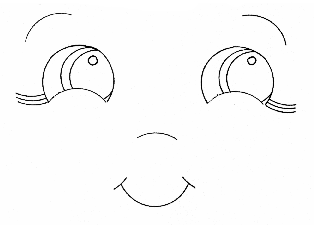
This face design can be shrunk down on a copy machine to
fit lots of doll sizes.
A more detailed face, designed totally by using drawn around objects and an eye shape and mouth shape from a greeting card. Only 1/2 of the mouth shape was good, so I used the folded label method to get a whole mouth shape so that it matched on both sides. The folded label method is described later in this lesson. I used a folded label for the eye shape too because I like both eyes to match.
Iris from a penny. Pupil from a pencil eraser. Top nose line from a nickel. Little freehand nose sides. Eyelashes from a quarter. Eyebrows from a jar lid.
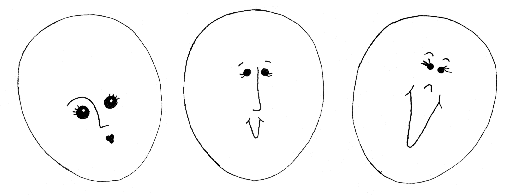
For primitive/country dolls, the face features are usually very simple lines and dots. With just a dab of practice these simple faces can be done freehand by most anybody.
Some simple Primitive/Country type faces.
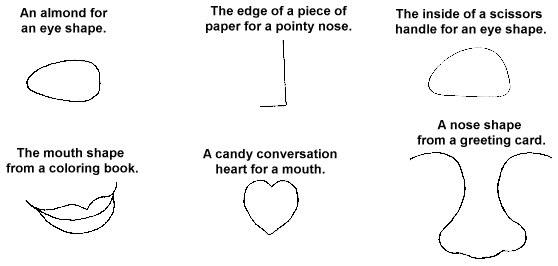
Practice designing lots of faces on paper. It is easier to draw the faces big, then shrink them down on a copy machine. There are a lot more things to draw around that are big too, and it’s easier to draw around big things. Some more ideas of things to draw around, or places to find features to use.
 Don’t
use features from other doll designer’s designs for your original doll
design. Also don’t use all of the features from a coloring book picture,
or greeting card face. Just a mouth shape or an eye shape, mixed with other
features you have designed yourself.
Don’t
use features from other doll designer’s designs for your original doll
design. Also don’t use all of the features from a coloring book picture,
or greeting card face. Just a mouth shape or an eye shape, mixed with other
features you have designed yourself.
If you just don’t want to do faces yourself, but love doing your own doll designs, you can use the Iron on faces from One and Only Creations. They are available at craft stores, fabric stores and from CR crafts. Be sure to iron them on before you stuff a head.
PRACTICE-PRACTICE-PRACTICE until you are thinking of “Places for Faces” and designing faces in your sleep!
Judi Ward
Judi's Dolls
http://JudisDolls.com

© 1998, Internet Visions Co. All rights reserved. All trademarks are owned by Internet Visions Company.